
The heater decides how a traditional sauna feels. The controls decide how much you think about it. Some owners want a knob they turn and forget. Others want the room hot when they pull into the driveway.
Many saunas let you choose the control type at order, and the listings say little about what you’re choosing between. This article explains the three kinds. For heater sizing and wiring, start with the traditional sauna buying guide.
Short answer: a dial heater is simple and already includes a delayed start. A digital or Wi-Fi control adds a temperature readout and remote start. Choose on how you’ll use the sauna, since the heat is the same.
How a dial heater works
Harvia’s KIP heater, offered on several saunas we list, has two knobs on the heater body.
The thermostat. A knob with no degrees marked on it. Harvia’s manual says to set it to maximum, heat the room for half an hour to an hour, and turn it back if the room is too hot. You set it once.
The timer. A single dial with two scales.
- The first scale is a 60-minute run timer. Turn it, and the heater runs for up to an hour and switches off by itself. Harvia notes it is quiet and doesn’t tick.
- The second scale, marked 1 to 8, is a delay. Set it to 3 and the heater comes on 3 hours later.
Here’s what the spec sheet won’t tell you: that second scale is a delayed start, on a heater with no app. Harvia’s own example: set it to 3, and the sauna is ready in three and a half hours, allowing half an hour to heat. The heater then shuts off after about another half hour unless you reset the timer.
So the basic heater already answers the question “can it be hot when I get home?” You do have to set it before you leave.
What the safety cutoffs do
The 60-minute limit is deliberate. The heater can’t be left running all day by accident. Harvia’s manual also describes a high limit control in each heater, a safety cutoff.
Whatever the control type, the manual’s warning applies: don’t place anything combustible over the heater, “towels, bathing suits, wooden bucket or dipper.” That matters most with any delayed or remote start, because nobody is in the room when the heater switches on.
Digital wall controls
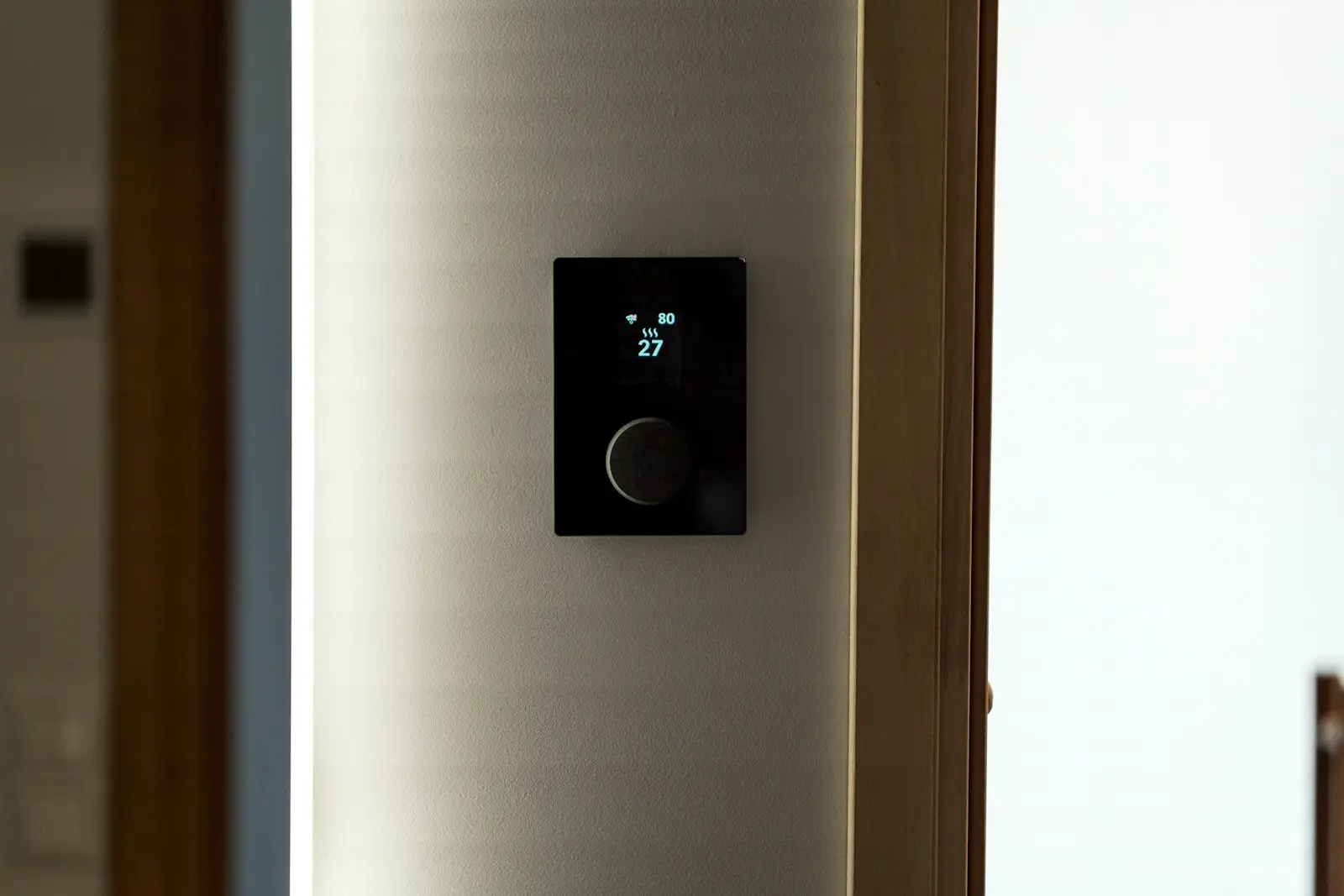
Some heaters have no knobs. A separate control panel on the wall outside the sauna runs them, through a power unit. Harvia’s manual covers a digital control of this type for its heaters and says the panel and power unit must be installed in a dry place.
What you gain is a temperature you set in degrees and can read from outside the room. What you add is a second box, more wiring, and electronics near a hot, damp room.
The hybrid cabins we list go further. The Finnmark FD-4 Trinity and FD-5 Trinity XL have a 5-inch touchscreen controller that runs both the infrared and the traditional side.
Wi-Fi and app controls
An app-controlled heater does what the wall control does, from your phone. You can start it from work, check the temperature from the couch, and set a schedule.
Among the saunas we list:
| Sauna | Control options in the listing |
|---|---|
| Almost Heaven Madison | KIP heater with dial, or Spirit heater with smart app control |
| Almost Heaven Salem | Dial-controlled or Wi-Fi smart-controlled heater |
| Almost Heaven Sutton | 6kW Harvia heater with a delayed-start option |
| Redwood Outdoors barrel | 6kW Harvia KIP included; Wi-Fi heater available as an upgrade |
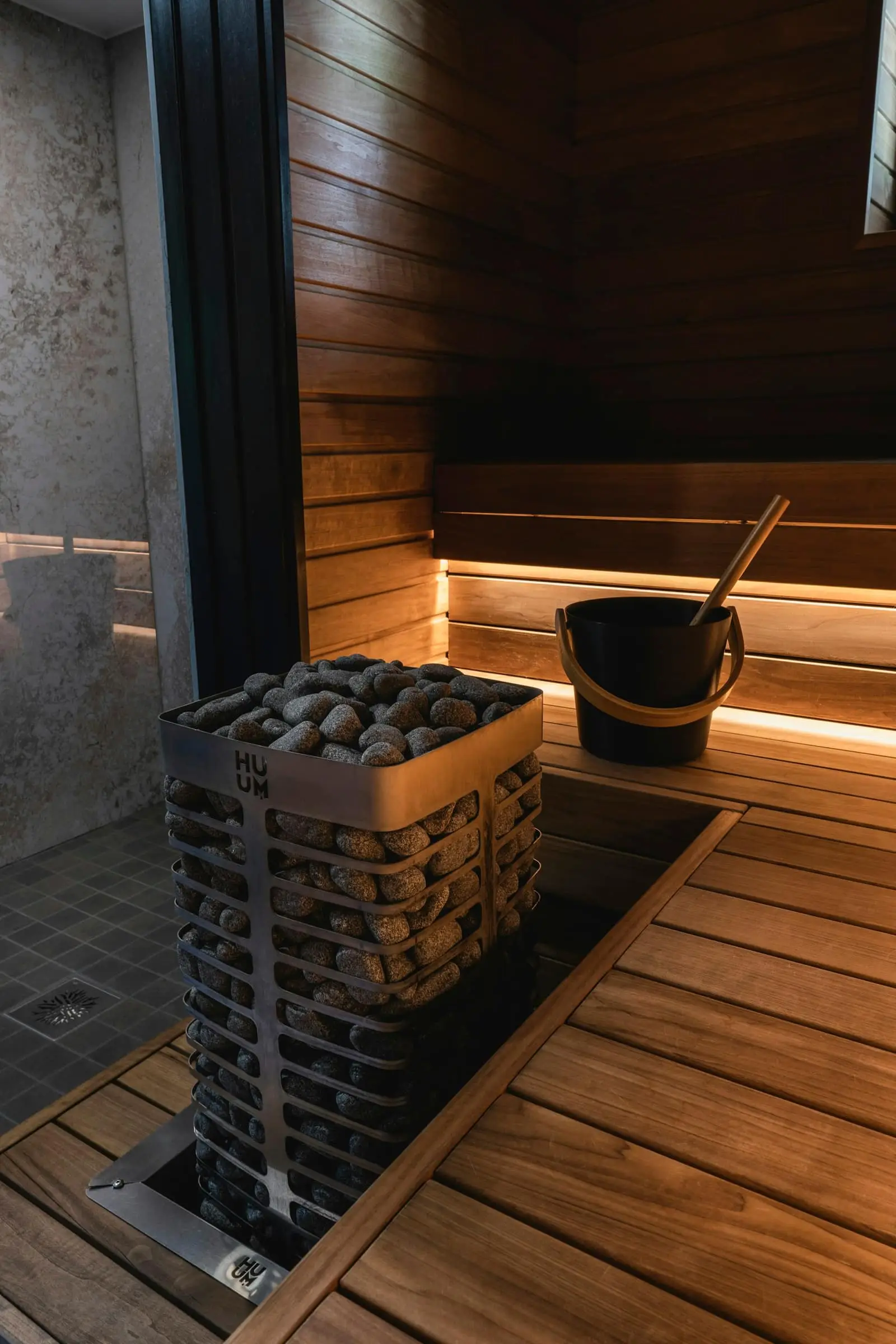
| SaunaLife Ergo E7 | Heater sold separately: Harvia KIP 6kW or HUUM DROP 6kW |
From dealer and manufacturer listings, checked September 2026. Our data doesn’t include the price difference between the dial and Wi-Fi options, so ask the dealer.
Run the numbers on convenience
Remote start doesn’t make the sauna heat faster. Harvia says to allow at least 30 minutes for the room to reach an average sauna temperature. An outdoor barrel in winter takes longer.
What remote start saves is the trip to the sauna to turn the knob, and the wait after it. If the sauna is in your basement, that trip is 20 steps. If it is at the end of the garden in January, it is worth more.
It also needs a Wi-Fi signal where the sauna stands. An outdoor sauna 60 feet from the house may be out of range. Check with your phone at the spot before you pay for the upgrade.
You get, you give up
Dial. You get the lowest price, nothing to pair or update, and a built-in delay of up to 8 hours. You give up a temperature readout and control from a distance.
Digital wall panel. You get a set temperature in degrees and a display outside the room. You give up some simplicity and pay for the extra unit and wiring.
Wi-Fi. You get remote start and scheduling. You give up independence from your network and from the maker’s app, which has to keep working for as long as you own the heater.
My rule of thumb: for a sauna inside the house, take the dial. For one across the yard that you’ll use on winter evenings, the Wi-Fi upgrade earns its price.
Before any unattended start
- Clear the heater. Nothing on it, nothing hanging over it.
- Close the door.
- Check that nobody will be surprised to find a hot room, children especially.
- Make sure the bench is clear.
To see how three traditional saunas compare, read our traditional sauna comparison.
Bottom line: every heater here gets the room to the same temperature. A dial is enough for most people, and it can already start the sauna while you’re out.
Sources
- Harvia, KIP electric sauna heater owner’s/operator’s manual (North America), September 17, 2015: almostheaven.net
- Almost Heaven, Redwood Outdoors, SaunaLife, and Finnmark listings (heater and control options), checked September 2026