
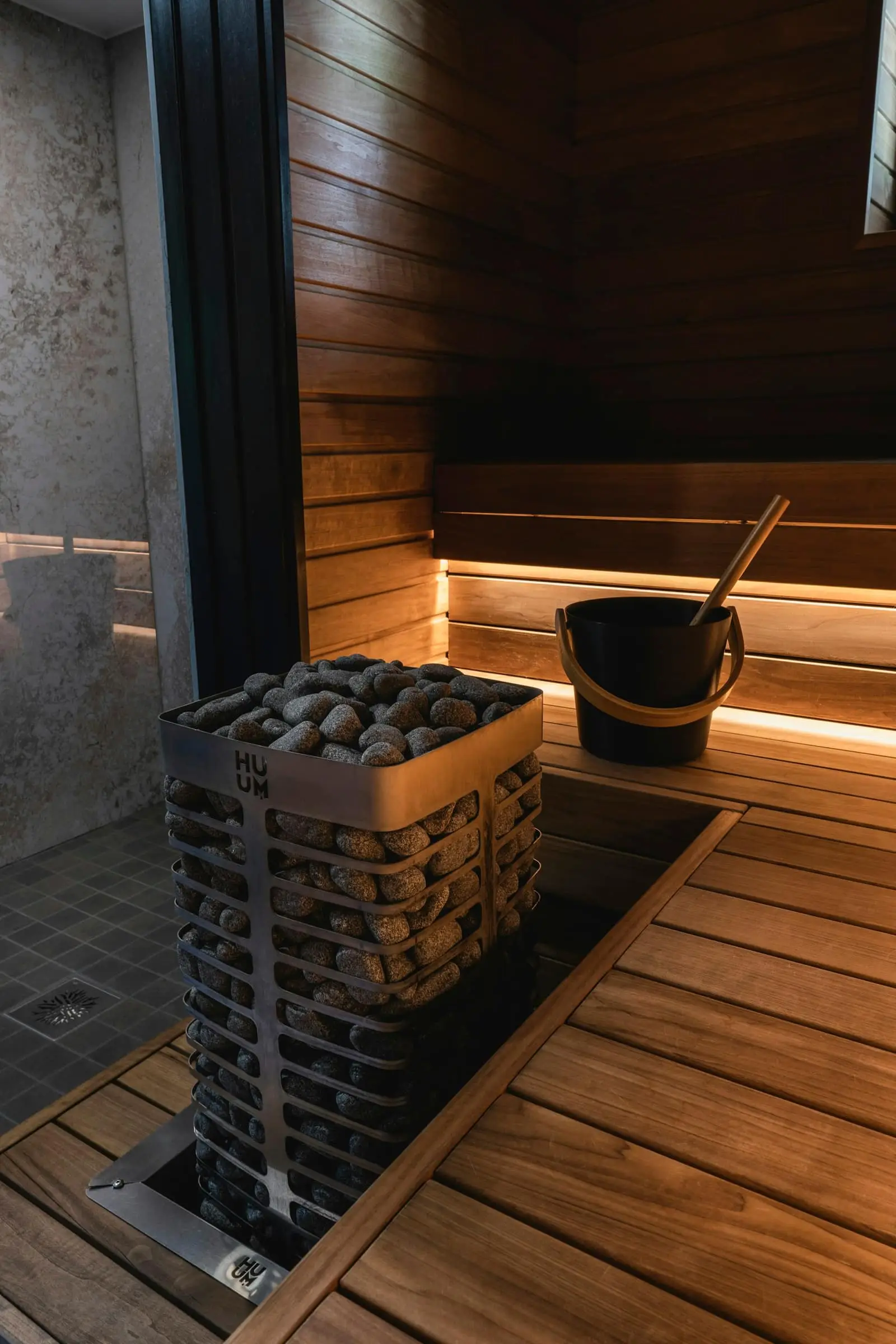
A traditional sauna is the classic Finnish idea: a wooden room, a stove topped with rocks, and steam when you ladle water on them. Home versions range from 2-person barrels in the backyard to 6-person cabins in the basement.
This guide covers the decisions specific to traditional heat, in the order to make them. Each section has its own deeper article on the site.
Short answer: choose electric or wood-burning first, size the heater to the room, and confirm the wiring or chimney before you pick a model.
Electric or wood-burning
Electric heaters are the default for most homes. They heat on a timer, need no firewood, and keep the temperature steady. They do need a dedicated 240V circuit.
Wood-burning stoves need no electricity for heat and give a softer, crackling session. You trade that for a chimney, firewood, and larger clearances: Harvia’s M3 stove, for example, needs 11.81 inches to combustible materials on every side and 3.94 feet to the ceiling.
Several barrels, like the SaunaLife Ergo E7 and the Canadian Timber Harmony, ship without a heater so you can choose either.
Heater sizing
Size the heater to the room’s volume, not its seat count. Harvia’s KIP manual rates the 4.5kW model for 100–210 cubic feet, the 6kW for 170–300, and the 8kW for 250–425. Glass and outdoor barrels push you toward the larger end.
Wiring an indoor sauna
Here’s what the spec sheet won’t tell you upfront: the heater sets your electrical work. Harvia’s KIP heaters draw 18.8 amps (4.5kW), 25 amps (6kW), or 33.3 amps (8kW) on 240V. The manual calls for copper wire rated for 90°C inside the sauna walls, and it says a ground fault interrupter (GFI) should not be used on the heater circuit. A licensed electrician handles this.
Planning a large room
For 4–6 person indoor rooms, ceiling height and ventilation matter as much as floor area. Harvia’s KIP heaters need at least 6 ft 2 in. of ceiling, and Harvia’s planning guide calls for the air to change about six times an hour, with the exhaust vent near the floor and away from the heater.
Barrels for two
A 2-person barrel is the most compact way into outdoor traditional heat. The Almost Heaven Salem measures 78 by 47 inches and includes a 6kW heater.
Löyly and the stones
Löyly is the steam from water on hot stones, and it’s half the point of a traditional sauna. Use one ladle at a time. Harvia suggests changing the stones about once a year if you use the heater twice a week, and sooner if they crumble.
The cool-down
Traditional sessions come in rounds: heat, cool down, rest, repeat. Plan somewhere to cool off between rounds, whether that’s a shower, a bench outside, or a cold plunge.
Shortlisting a model
Our traditional sauna comparison puts an indoor heater-included cabin next to an outdoor barrel with a choice of heater. If you’re still choosing between heat types, the home sauna buying guide and the infrared sauna buying guide cover the alternatives.
Bottom line: in a traditional sauna, the heater decides almost everything else. Choose it first.
Sources
- Cleveland Clinic, “Why Infrared Saunas Are ‘Cooler’ Than Traditional Saunas,” April 14, 2022: health.clevelandclinic.org
- Harvia, KIP electric sauna heater instructions for installation and use (North America), September 17, 2015: almostheaven.net
- Harvia, sauna room planning and installation instructions (ventilation), April 16, 2015: aqualityleisure.net
- Harvia, M3 wood-burning heater product page, accessed October 2, 2026: harvia.com
- Harvia Support, “How often should the heater stones be changed in a family sauna?” accessed October 2, 2026: support.harvia.com
- thisisFINLAND, “Bare facts of the sauna in Finland” (Finnish Sauna Society temperature guidance), accessed October 2, 2026: finland.fi
- Product specifications: Almost Heaven, SaunaLife, and Canadian Timber listings via Select Saunas, checked October 1, 2026