
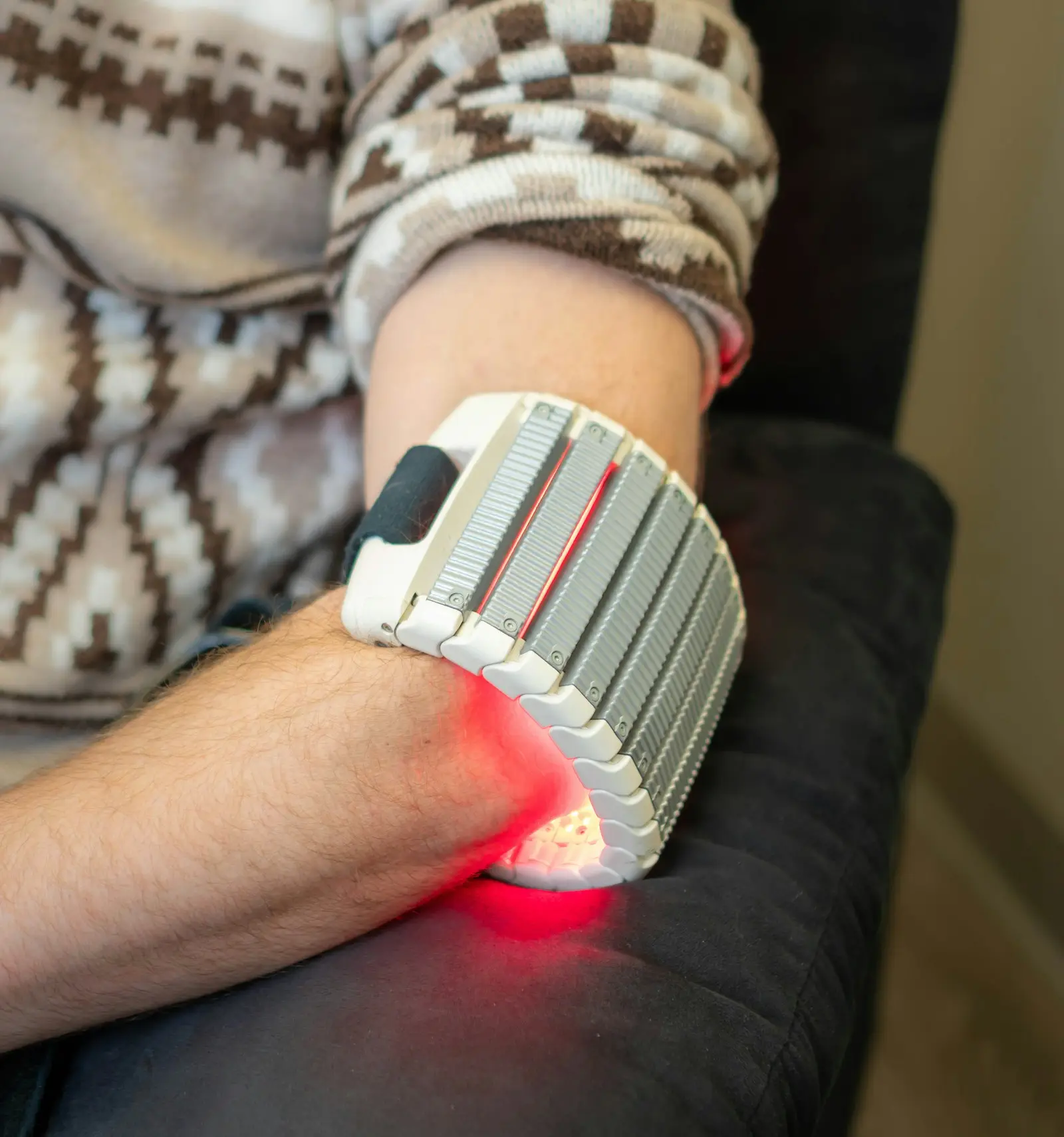

Red light panels are sold by their wavelengths. A listing will say “660nm and 850nm,” or list four numbers, as if more were better. The numbers mean something, but less than the marketing suggests.
This article explains what the wavelengths are and what the devices we list publish. For panels, mats, blankets, and other devices together, start with the home wellness equipment guide.
Short answer: 630 and 660nm are visible red light. 810, 830, and 850nm are invisible near-infrared. Most panels give you both. A published wavelength tells you the color of the light, not how much reaches you.
What a nanometer measures
Light travels as a wave, and a nanometer (nm) is the unit for the length of that wave. Different lengths are different colors. Red sits at the long end of what the eye can see. Past it, the light is still there but invisible. That band is called near-infrared.
So a panel with 660nm and 850nm LEDs has two kinds of light: red you can see, and near-infrared you can’t.
What the devices publish
| Device | Price | Red | Near-infrared | LEDs |
|---|---|---|---|---|
| MitoPRO 1000+ | $869 | 630nm, 660nm | 830nm, 850nm | 200 |
| MitoPRO 1500+ | $1,169 | 630nm, 660nm | 830nm, 850nm | 300 |
| Joovv Mini 3.0 | $1,099 | 660nm | 850nm | 60 |
| Hooga Red Light PEMF Mat | $1,199 | 630nm, 660nm | 810nm, 850nm | 150 |
| Joovv Solo 3.0 | $1,699 | Not published | Not published | Not published |
From manufacturer listings, checked September 2026. The Mito panels split their output evenly, 25% to each of four wavelengths. The Joovv Mini and the Hooga mat are half red, half near-infrared by LED count.
Why half your panel looks off
Here’s what the spec sheet won’t tell you, and it surprises new owners. The near-infrared LEDs look dark when the panel is on. Some glow a faint pink. They aren’t broken. The eye can’t see 810 to 850nm light.
On a panel that is half near-infrared, every second LED will look unlit. If you want to check them, some phone cameras pick up near-infrared as a pale glow.
Because you can’t see it, you also can’t tell how bright it is. Don’t stare into the panel to check. Cleveland Clinic’s advice for at-home devices is to “make sure to shield your eyes for protection.” Use the goggles that come in the box.
Does the wavelength change what it does?
Cleveland Clinic says “the wavelength affects how deeply the light penetrates your skin.” It also says red light therapy is thought to work by acting on mitochondria, the part of a cell that produces energy.
That is as far as a careful source goes. The same page says “there’s not enough evidence to support most uses” of red light therapy, and that more studies are needed. So I wouldn’t choose between 630 and 660nm, or between 830 and 850nm, on the strength of a product page. The research doesn’t support that kind of fine-tuning for a home buyer.
Two wavelengths or four?
The Mito panels use four wavelengths and the Joovv Mini uses two. Four sounds better. In practice, 630 and 660nm are both red, and 830 and 850nm are both near-infrared. A four-wavelength panel covers the same two bands with two shades of each.
The total output is the same LEDs divided more ways. I’d treat two against four as a tie and compare the things you can measure.
What to compare instead
Output. Wavelength is the color. Irradiance is the amount, in milliwatts per square centimeter at a stated distance. Mito publishes it: above 165 mW/cm² at 6 inches on a professional meter for the 1000+. Joovv gives above 100 mW/cm² for the Mini without a distance in our data. Ask for the distance.
Size. A 12 x 36 inch panel covers three times the area of a 15 x 8.75 inch one.
What’s missing. Joovv doesn’t publish wavelengths or irradiance for the Solo 3.0 in our data. At $1,699, I’d want both before buying.
Clinic or home. Cleveland Clinic notes at-home devices “may be less powerful than devices that may be used by dermatologists or other trained skin professionals.” Set your expectations to match.
Using one sensibly
- Follow the maker’s distance and session time.
- Wear the goggles.
- If you take a medicine that makes you sensitive to light, ask your doctor first.
Bottom line: red is visible, near-infrared isn’t, and most panels have both. Buy on published output, size, and warranty. The exact nanometers are the least important line on the listing.
This article is general information, not medical advice.
Sources
- Cleveland Clinic, “Red Light Therapy: Benefits, Side Effects & Uses,” last updated December 1, 2021: my.clevelandclinic.org
- Mito Red Light, Joovv, and Hooga listings (wavelengths, LED counts, irradiance, dimensions, price), checked September 2026