
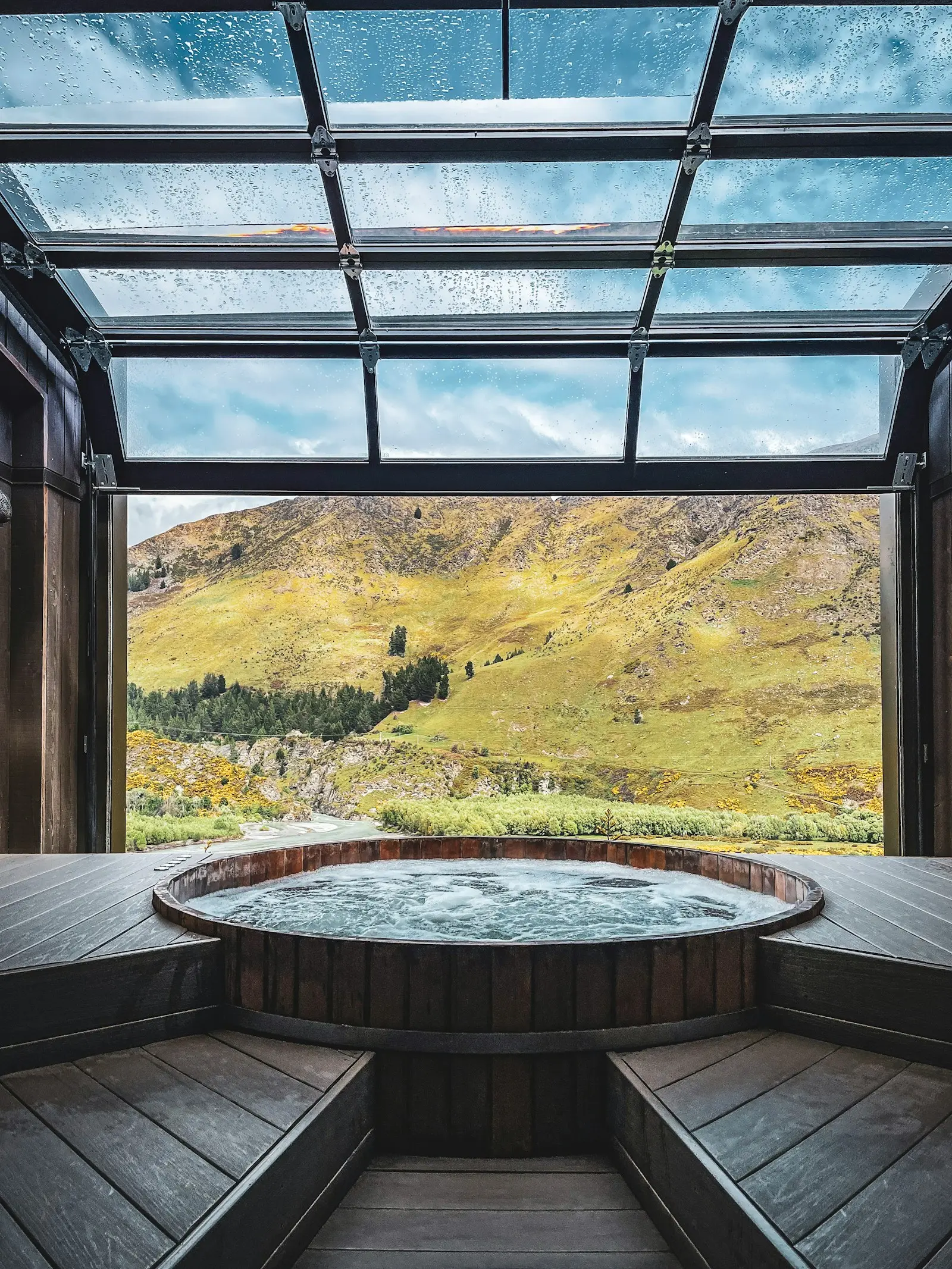

You fill a new hot tub from the garden hose, switch it on, and then wait. How long depends on two numbers that are both on the spec sheet: how many gallons it holds and how many kilowatts the heater puts out.
This article shows the arithmetic and the wait for the spas we list. For the rest of the buying decisions, start with the hot tub buying guide.
Short answer: on a 120V plug, plan on a full day. On a 240V circuit with a 4kW heater, plan on an afternoon. The larger the spa, the longer both take.
The formula
Heat is measured in Btu. One Btu raises 1 lb of water by 1°F, and 1 kWh of electricity is 3,412 Btu. A gallon of water weighs 8.34 lbs.
Hours = gallons x 8.34 x degrees to rise ÷ 3,412 ÷ heater kW
Take a 160-gallon spa filled with 60°F water and heated to 102°F. That is a 42°F rise. 160 x 8.34 x 42 is about 56,000 Btu, or 16.4 kWh. A 1kW heater needs 16.4 hours. A 4kW heater needs 4.1.
The chart
Minimum time to heat a full spa from 60°F to 102°F:
| Spa | Volume | Energy | 1kW heater | 4kW heater |
|---|---|---|---|---|
| Hot Spring Mini | 125 gal | 12.8 kWh | 13 hours | 3 hours |
| AquaRest Discover Premium 300 | 160 gal | 16.4 kWh | 16 hours | 4 hours |
| Bestway SaluSpa Hot Springs | 177 gal | 18.2 kWh | 18 hours | 5 hours |
| AquaRest Discover Standard 400 | 190 gal | 19.5 kWh | 20 hours | 5 hours |
| Hot Spring Azure | 235 gal | 24.1 kWh | 24 hours | 6 hours |
| AquaRest Discover Premium 600 | 240 gal | 24.6 kWh | 25 hours | 6 hours |
| Jacuzzi J-335 | 360 gal | 37.0 kWh | 37 hours | 9 hours |
Volumes from manufacturer and retailer listings, checked September 2026. Times are our arithmetic for two example heater sizes.
Two cautions about this chart. First, only the AquaRest Premium spas publish their heater size in our data: 1kW on 120V and 4kW on 240V. For the others, the two columns show what each heater size would do, not what the spa ships with. Ask the dealer for the heater kW. Second, these are minimums. A spa loses heat through its shell and cover while it warms, so the real wait is longer, and longer still on a cold night.
Why 120V spas are slow
Here’s what the spec sheet won’t tell you. A standard 120V/15A outlet can supply about 1.8kW in total, and the spa’s pump and controls need some of that. So plug-in spas ship with small heaters, about 1kW in the AquaRest models.
At 1kW, a 160-gallon spa gains about 2.6°F an hour. A 240-gallon spa gains about 1.7°F an hour. On many plug-in spas the heater also pauses when the jets run on high, so the water cools while you soak.
On 240V the same AquaRest heater runs at 4kW. That is four times the heat, so about 10°F an hour for 160 gallons and 7°F an hour for 240.
Your tap water changes the answer
The chart assumes 60°F fill water. In winter, the supply can be much colder. From 50°F to 102°F is a 52°F rise, which adds about a quarter to every figure. The 160-gallon spa goes from 16.4 kWh to about 20.3 kWh, and from 16 hours to 20 on a 1kW heater.
In summer the opposite happens. From 70°F, the same spa needs about 12.5 kWh and 12.5 hours.
What the first heat costs
Run the numbers at the 2026 US residential average of 18.34 cents per kWh:
- 160 gallons: 16.4 kWh, about $3.00
- 240 gallons: 24.6 kWh, about $4.50
- 360 gallons: 37.0 kWh, about $6.80
The heater size doesn’t change these. A 1kW heater and a 4kW heater use the same energy to do the same job. One takes four times as long. What does change the bill is heat loss during a long warm-up, which is another reason the slow route costs a little more.
Heating from cold is a small part of running a spa. Holding the temperature day after day costs more over a month, and that depends on the cover and insulation.
How to wait less
- Keep the cover on while it heats. Much of the heat leaves through the water surface.
- Fill with warm water if your water heater allows it. Check the spa manual first, since some makers set a maximum fill temperature.
- Don’t drain more often than you need to. Every refill starts the clock again.
- Leave it at temperature. Reheating from cold for each use takes longer than holding the heat under a good cover.
- Stop at 104°F. The CDC says hot tub water should not go above 104°F.
My rule of thumb: for a spa over 200 gallons, plan for the 240V circuit from the start. On a wall outlet, a spa that size takes a full day to recover from a refill.
To see how three spas at different prices compare, read our hot tub comparison.
Bottom line: gallons times degrees, divided by heater size. Do the sum before you buy, and you’ll know whether you’re waiting four hours or twenty-four.
Sources
- U.S. Energy Information Administration, “British thermal units (Btu),” accessed October 5, 2026: eia.gov
- U.S. Geological Survey, “Water Density” (a gallon of water weighs about 8.34 lbs), accessed October 2, 2026: usgs.gov
- U.S. Energy Information Administration, Electric Power Monthly, Table 5.6.A (residential average 18.34¢/kWh, June 2026 data), accessed October 1, 2026
- Centers for Disease Control and Prevention, “What You Can Do to Stay Healthy in Hot Tubs,” updated May 20, 2025
- AquaRest, Hot Spring, Bestway, and Jacuzzi listings (volume, heater size), checked September 2026