

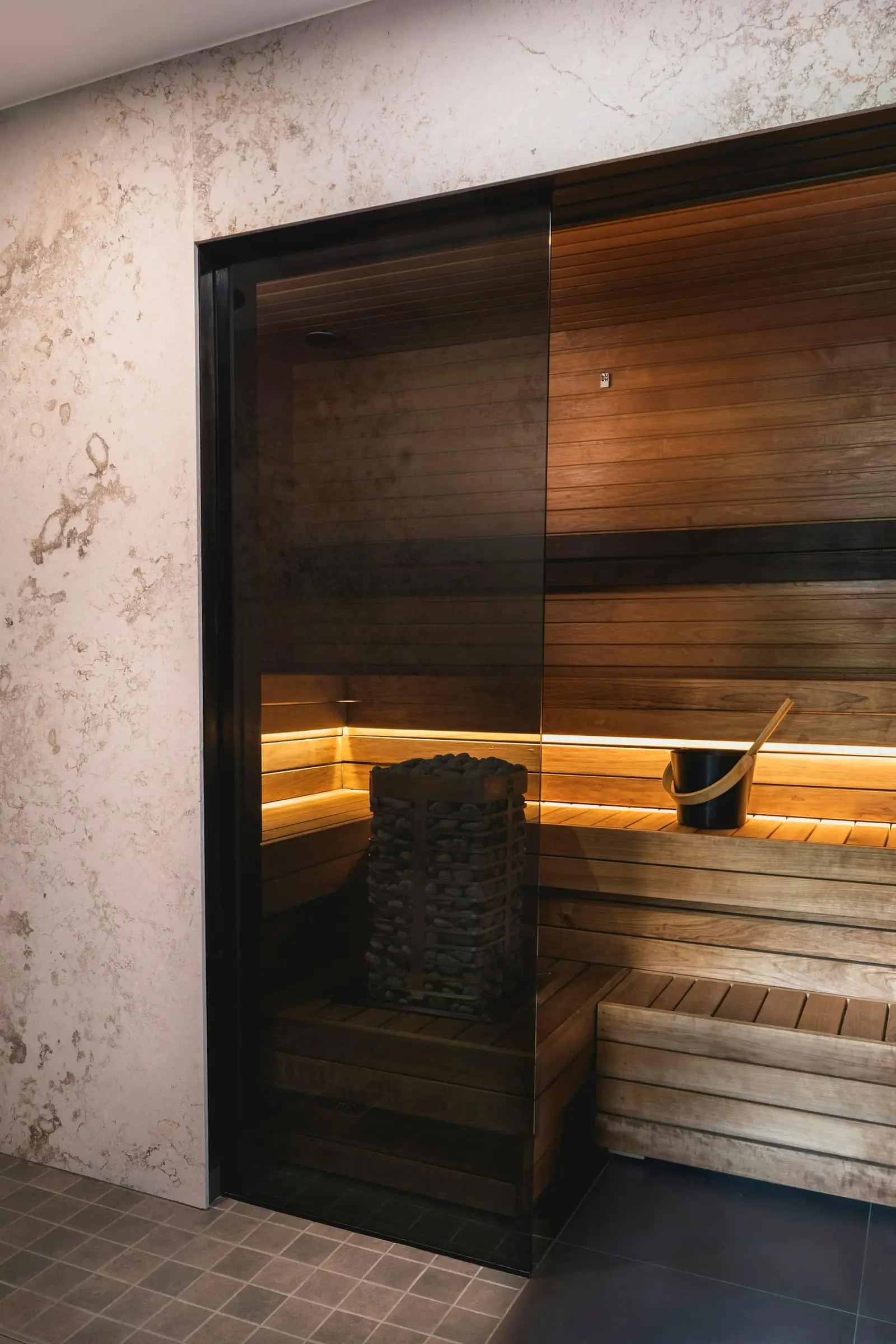
Most modern home saunas use at least some glass, usually a door and sometimes a whole front wall. It changes how the sauna looks, how the room around it feels, and how much heater the cabin needs.
This article is only about that layout choice: big glass or mostly wood. For the rest of the buying process, see the home sauna buying guide.
Short answer: glass fronts make a small room feel bigger and look striking, but they cost some privacy and need a slightly larger heater. Fully enclosed cabins hold heat more easily and feel more traditional.
What glass changes
You get light and openness with a glass front. In a basement or a narrow room, a glass wall stops the sauna from feeling like a closet. Outdoors, it frames a view.
You give up two things. Privacy is the obvious one. The less obvious one is heat: glass doesn’t insulate like a solid wood wall.
Heater sizing with glass
Here’s what the spec sheet won’t tell you: glass changes the heater math. A common sizing rule is about 1kW per 45–50 cubic feet of well-insulated room. Sizing guides then recommend adding about 1kW for each large window or uninsulated wall, and upsizing 25–50% for barrel saunas, outdoor cabins, and rooms with glass doors (2026 sizing guide).
If you buy a cabin with the heater included, the manufacturer has already done this. If you buy the heater separately, account for the glass.
Privacy options
Tinted glass is the simplest fix. The Almost Heaven Sutton uses a tempered, tinted glass door. Placement matters too: face the glass toward a wall or a private part of the yard, not toward the street or a busy room.
Side by side
| Glass front | Fully enclosed | |
|---|---|---|
| Feel | Open, bright | Cozy, traditional |
| Privacy | Lower; needs placement or tint | High |
| Heater sizing | Size up for glass | Standard sizing |
| Cleaning | Glass shows water spots | Wood only |
| Example | SaunaLife G4 (full glass front, side window) | Most barrel and cabin saunas with a glass door only |
How much glass, model by model
| Sauna | Glass (per listing) |
|---|---|
| SaunaLife Model G4 | Full glass front, large side window, lockable glass door |
| SaunaLife Model X7 | Full 5/16 in. glass front |
| Dundalk Georgian Cabin | Two front windows, 5mm bronze tempered glass |
| SaunaLife Model X2 | 8mm tempered glass door |
| Almost Heaven Madison | Glass door, full or half-and-half |
| Dynamic Andora (infrared) | Clear glass door with side windows |
From manufacturer and dealer listings, checked September–October 2026.
There is a range between “glass door only” and “glass wall”. The Madison lets you choose a half-glass door, which is the most private option here. Bronze or tinted glass, as on the Georgian and the Sutton, cuts the view in without losing the light.
Run the numbers with this article’s sizing rule
Take the rule above, 1kW per 45 to 50 cubic feet, and apply it to the two full-glass cabins. Both ship without a heater.
Model G4. The interior is 78 x 78 x 85.2 inches, about 300 cubic feet. The base rule gives 6 to 6.7kW. Add 25 to 50% for the glass and the outdoor setting and you get about 7.5 to 10kW.
Model X7. The interior is 62 x 79 x 77.5 inches, about 220 cubic feet. The base rule gives 4.4 to 4.9kW. Add 25 to 50% for the glass front and you get about 5.5 to 7.3kW.
That is our arithmetic from a general rule, not SaunaLife’s recommendation. It shows the size of the effect: glass can move a cabin up a whole heater size, and a bigger heater can mean a bigger circuit. Neither listing names a heater, so ask the dealer which one SaunaLife specifies.
Looking after the glass
Glass shows every water spot. Wipe it with a soft cloth after a session while it is still warm. Harvia’s heater manual suggests sealing the wood around the glass in the door, inside and out, to prevent warping. That is the only place it recommends a sealer in a sauna.
Check the door seal each season. A glass door that no longer closes snugly leaks more heat than the glass itself.
Which suits you
My rule of thumb: in a small indoor room or a backyard with a view worth seeing, glass is worth it. In a shared space, or when you want the most heat from the smallest heater, go mostly enclosed.
To see how the doors and layouts compare across current picks, our home sauna comparison lists each cabin’s specs side by side.
Bottom line: choose glass for the room, not just the photo. Decide where the glass will face before you fall in love with the design.
Sources
- The Sauna Republic, “What Size Sauna Heater Do I Need?” 2026: thesaunarepublic.com
- Haven of Heat, “Harvia Sauna Heater Buyer’s Guide 2026”: havenofheat.com
- Door and glass specifications: Almost Heaven, SaunaLife, Golden Designs, and Finnmark listings, checked October 1, 2026
- Harvia, KIP electric sauna heater owner’s/operator’s manual (North America), September 17, 2015: almostheaven.net
- Glass and interior dimensions: SaunaLife, Dundalk Leisurecraft, Almost Heaven, and Dynamic listings, checked September–October 2026