
Ask ten sauna owners what temperature they run at and you’ll get ten numbers. Some of that is taste. Most of it is that their thermometers are in different places.
A traditional sauna doesn’t have one temperature. It has a hot layer at the ceiling and a much cooler one at the floor. This article covers the normal range, what your thermometer is telling you, and how to choose a setting. For heaters, wiring, and sizing, start with the traditional sauna buying guide.
Short answer: 160 to 185°F, read near the ceiling above the heater. Where you sit, it is 40°F cooler than that. Set the dial by how the upper bench feels after 30 minutes of heating.
The normal range
Harvia, which makes the heaters in several of the saunas we list, gives 160 to 185°F as the normal sauna temperature in its KIP heater manual. Finnish guidance is a little higher: thisisFINLAND quotes 80 to 100°C, which is 176 to 212°F.
Makers publish maximums in the same region. Almost Heaven says the Grandview barrel reaches 190 to 195°F. The traditional stove in the Finnmark FD-4 Trinity lists a maximum of 190°F.
One room, four temperatures
Here’s what the spec sheet won’t tell you. Harvia’s manual gives an example of how one sauna reads at four heights:
| Where you measure | Reading |
|---|---|
| Above the heater, near the ceiling | 180°F |
| Opposite wall | 165°F |
| Upper bench level | 140°F |
| Lower bench level | 120°F |
From the Harvia KIP owner’s manual. It notes that readings vary with room height and thermometer location.
That is a 60°F spread in one small room. So “my sauna only gets to 150°F” may mean the thermometer hangs at shoulder height on the far wall, and the sauna is fine.
It also explains the benches. The upper bench is the hot seat. The lower bench is where you sit to ease in, cool off without leaving, or bring a first-timer.
Where the thermometer goes
Harvia says to mount it above the heater, 6 inches from the ceiling, “for correct temperature reading.” That gives you the number the 160 to 185°F range refers to.
Finnleo’s advice for its own thermometer is about 1 foot down from the ceiling and at least 3 feet from the heater and the door. That reads a little lower and closer to what you feel.
Either works. Pick one spot, leave the thermometer there, and learn what its numbers mean for you. A gauge like the Harvia Thermo-Hygrometer adds humidity, which matters as soon as you pour water.
How long it takes
Harvia says to allow at least 30 minutes for the room to heat to an average sauna temperature. Its troubleshooting section lists impatience first: if the room isn’t hot, wait the full half hour before looking for a fault.
Three things make it slower:
- A heater that is small for the room. Check the maker’s table of kW against cubic feet.
- A cold start. An outdoor barrel in winter begins far lower than an indoor cabin.
- An open upper vent. Harvia notes the room heats faster with the higher vent closed during warm-up. The lower vent can stay open.
Setting the dial
Heaters with built-in controls have a thermostat knob with no degrees on it. Harvia’s method: turn it to maximum, heat for half an hour to an hour, and see how the room feels. If it is too hot, turn the knob back a little at a time until it suits you. Then leave it there.
So you set a traditional sauna by feel, once, and the thermometer tells you what that setting turned out to be.
Humidity changes everything
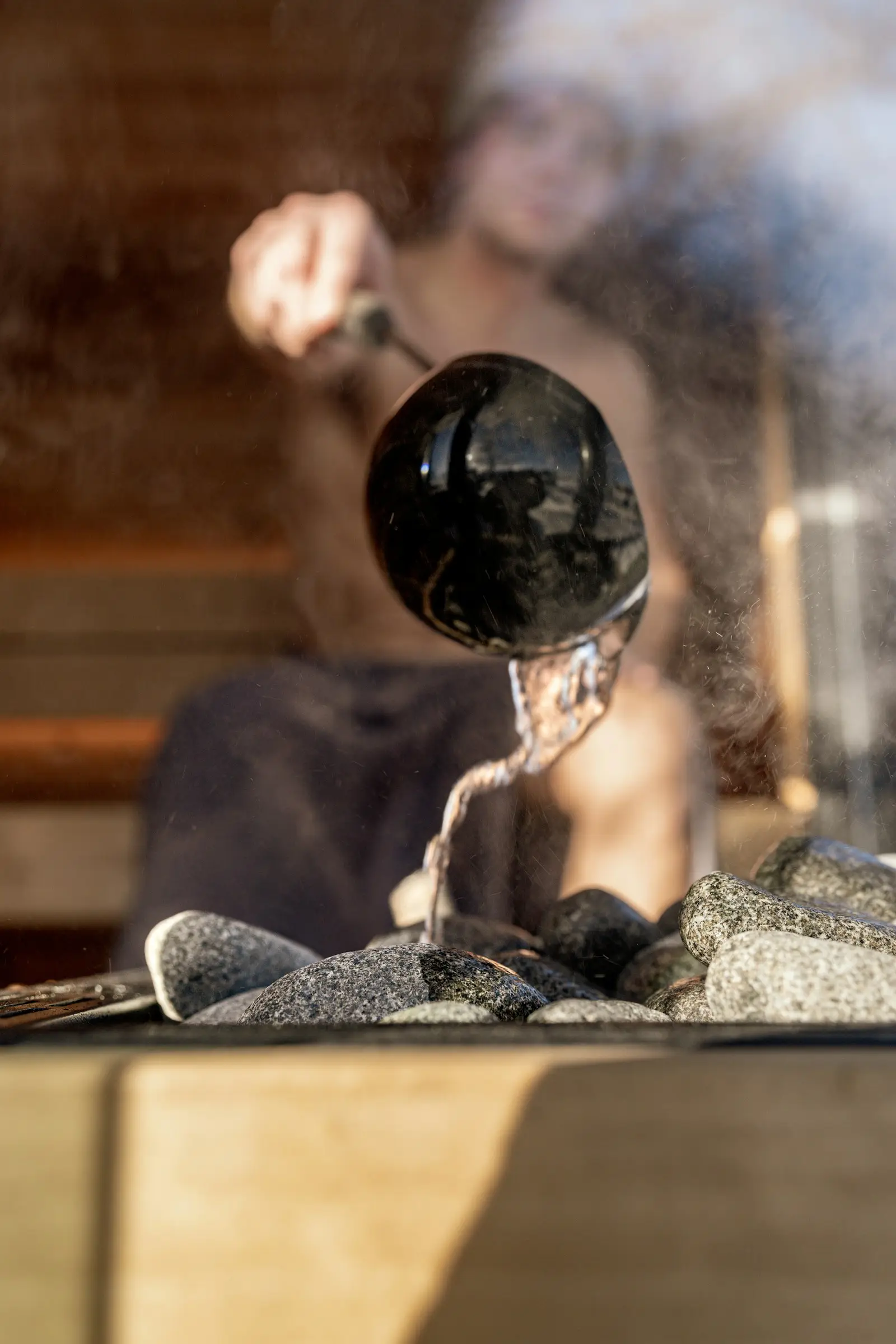
A dry sauna at 180°F is easy to sit in. Pour a ladle of water on the stones and the same 180°F feels far hotter for a minute or two. The steam, called löyly, raises the humidity, and damp air carries heat to your skin faster.
That is why two people can disagree about a sauna at the same temperature. One poured water. Use clean tap water only. Harvia warns that pool or spa water on the stones can produce chlorine gas and damage the elements.
How hot is too hot?
Harvia’s manual says not to exceed 30 minutes in the sauna at one time, and that it “should not be used as an endurance test.” Cleveland Clinic suggests starting with 5 minutes and keeping sessions to 15 to 20. It says to leave if you feel unwell, dizzy, or weak.
My rule of thumb: if you can’t sit on the upper bench for 10 minutes, turn the dial down or move down a bench. Hotter is not better.
To see how three traditional saunas compare, read our traditional sauna comparison.
Bottom line: aim for 160 to 185°F at the ceiling, expect about 140°F where you sit, and give the heater half an hour. Set the dial once by feel, then trust it.
This article is general information, not medical advice.
Sources
- Harvia, KIP electric sauna heater owner’s/operator’s manual (North America), September 17, 2015: almostheaven.net
- Finnleo, 4” Round Thermometer product page (mounting advice), accessed October 8, 2026: finnleo.com
- thisisFINLAND, “Bare facts of the sauna in Finland” (Finnish Sauna Society temperature guidance), accessed October 2, 2026: finland.fi
- Cleveland Clinic, “Get Your Sweat On: The Benefits of a Sauna,” August 12, 2024: health.clevelandclinic.org
- Almost Heaven Grandview and Finnmark FD-4 Trinity listings (maximum temperature), checked September 2026