
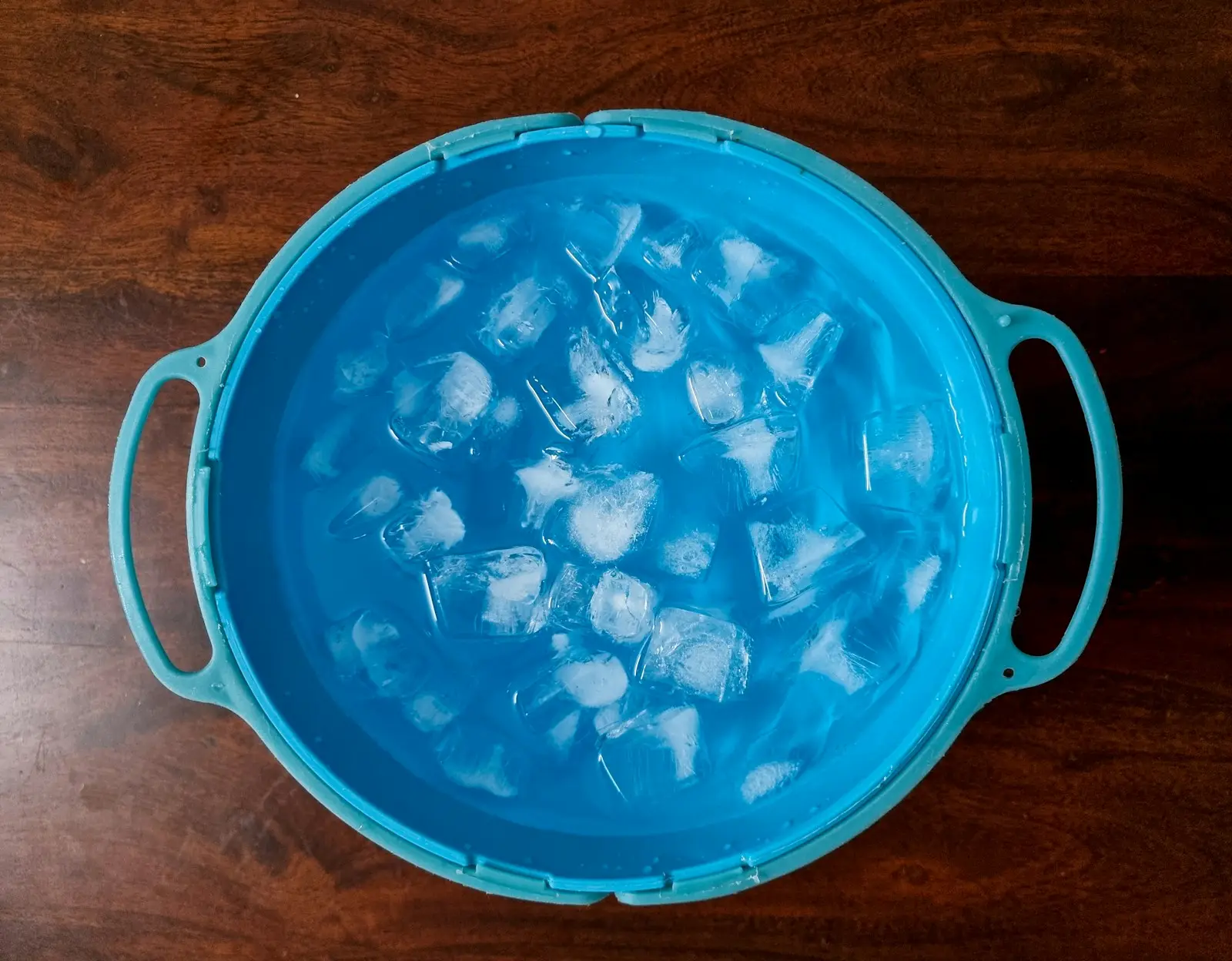
Most ice bath advice says “add a few bags.” That works until the day your tap water runs warm, the water barely cools, and you’ve used every bag in the freezer.
The amount of ice you need is arithmetic. It depends on three things: how much water is in the tub, how warm that water starts, and how cold you want it. This article gives you the formula and a chart. For choosing a tub, start with the ice bath buying guide.
Short answer: to cool water by 10°F to a 50°F target, you need about half a pound of ice per gallon. To cool it by 20°F, about 1 lb per gallon. To cool it by 30°F, about 1.5 lbs per gallon.
The formula
Ice cools water in two steps. Melting absorbs heat: about 144 Btu for every pound of ice (334 kJ per kg). Then the meltwater, which starts at 32°F, warms up to the bath temperature and absorbs a little more.
A Btu is the heat that changes 1 lb of water by 1°F, and a gallon of water weighs 8.34 lbs. Put together:
Ice in lbs = gallons x 8.34 x degrees to drop ÷ (144 + target temperature − 32)
For a 50°F target, the bottom number is 162. So 100 gallons cooled from 70°F to 50°F needs 100 x 8.34 x 20 ÷ 162, which is about 103 lbs.
The chart
Pounds of ice to bring a full tub down to 50°F:
| Tub | Listed volume | From 60°F | From 70°F | From 80°F |
|---|---|---|---|---|
| Ice Barrel 300 | 77 gal | 40 lbs | 79 lbs | 119 lbs |
| The Cold Pod | 85 gal | 44 lbs | 88 lbs | 131 lbs |
| Polar Recovery Ice Bath | 98 gal | 50 lbs | 101 lbs | 151 lbs |
| SereneLife 105 Gallon | 105 gal | 54 lbs | 108 lbs | 162 lbs |
| Nurecover Pod | 106 gal | 55 lbs | 109 lbs | 164 lbs |
| SaluSpa Arctic Ice | 111 gal | 57 lbs | 114 lbs | 171 lbs |
| The Cold Pod XL | 116 gal | 60 lbs | 119 lbs | 179 lbs |
| Icebound Essentials XL | 150 gal | 77 lbs | 154 lbs | 232 lbs |
Volumes from manufacturer and retailer listings, checked September to October 2026. Ice figures are our arithmetic. They are minimums: they ignore heat coming in from the air, the tub walls, and your body.
Run the numbers on your own water
The starting temperature matters more than the tub. Look across any row: going from 60°F tap water to 80°F tap water triples the ice.
So measure before you buy ice. Fill the tub, drop in a thermometer, and read it. A floating thermometer costs $17.99. In a cold climate in winter, the tap may already be at or below 50°F and you need no ice at all. In a hot climate in summer, an ice-only routine gets expensive quickly.
You don’t fill to the brim
Listed volumes are for a full tub, and you displace water when you get in. If you fill to three quarters, scale the chart to match: three quarters of the water needs three quarters of the ice.
Here’s what the spec sheet won’t tell you. A bigger tub costs you more ice every session, for as long as you own it. The Icebound Essentials XL needs 77 lbs where The Cold Pod needs 44 lbs, from the same 60°F water. Buy the size you fit in, not the largest one.
Ways to use less
- Start with colder water. Fill in the evening or early morning, when the supply and the air are cooler.
- Keep the lid on. Between sessions, a cover slows the water warming back up, so the next top-up is smaller.
- Keep it in the shade. Direct sun adds heat all day.
- Choose better insulation. Thicker or multi-layer walls slow heat gain. The Ice Barrel 500 publishes an R-16 rating for its walls and lid.
- Make some of it. Haldane’s silicone molds freeze 6 lb of block ice per batch, per the listing. That suits topping up rather than a full fill.
- Raise the target. Cooling to 55°F instead of 50°F cuts the ice by a quarter or more. From 70°F, that is 15°F to drop instead of 20°F.
When ice stops making sense
Add up a month. Three sessions a week at 60 lbs each is about 780 lbs of ice. Multiply by what a 20 lb bag costs where you live. If a year of ice costs more than a small chiller system, the chiller is the cheaper route. The cold plunge buying guide covers that choice.
Safety
Cleveland Clinic suggests beginners start at 50 to 59°F and says never to stay in for more than 5 minutes. Colder is not better. Check the thermometer after the ice has melted and you’ve stirred the water, because the top layer near the ice reads colder than the rest.
To compare three tubs at different prices, see our ice bath comparison.
Bottom line: half a pound of ice per gallon for every 10°F you need to drop. Measure your tap water first, and you’ll know what each session costs.
Sources
- Physics LibreTexts, “Phase Change and Latent Heat” (334 kJ/kg), accessed October 2, 2026: libretexts.org
- U.S. Energy Information Administration, “British thermal units (Btu),” accessed October 5, 2026: eia.gov
- U.S. Geological Survey, “Water Density” (a gallon of water weighs about 8.34 lbs), accessed October 2, 2026: usgs.gov
- Cleveland Clinic, “Are ‘Cold Plunge’ Ice Baths Good for You?” May 8, 2026: health.clevelandclinic.org
- Product volumes and prices: Ice Barrel, The Cold Pod, Polar Recovery, SereneLife, Nurecover, Bestway, and Icebound listings, checked September to October 2026