
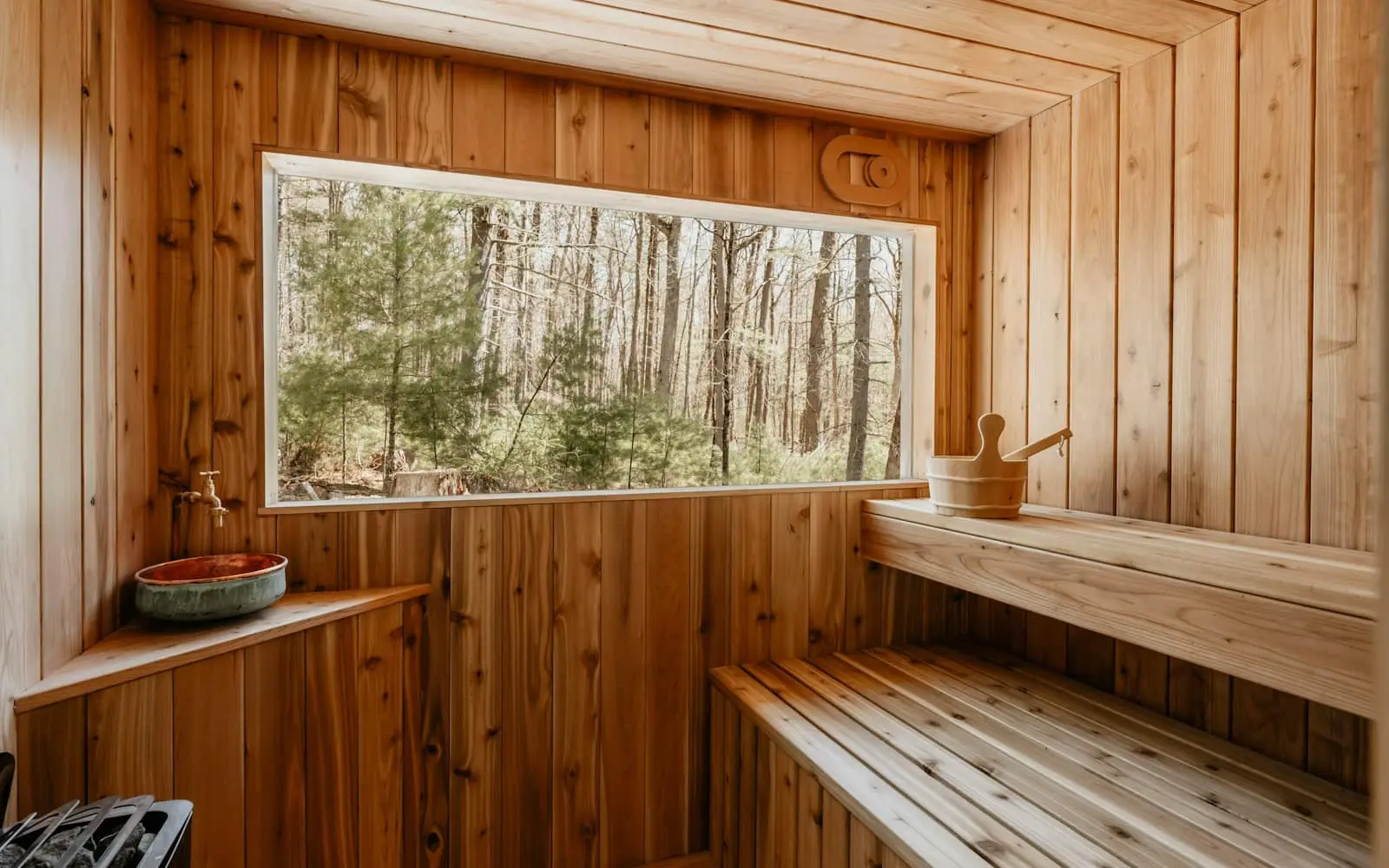
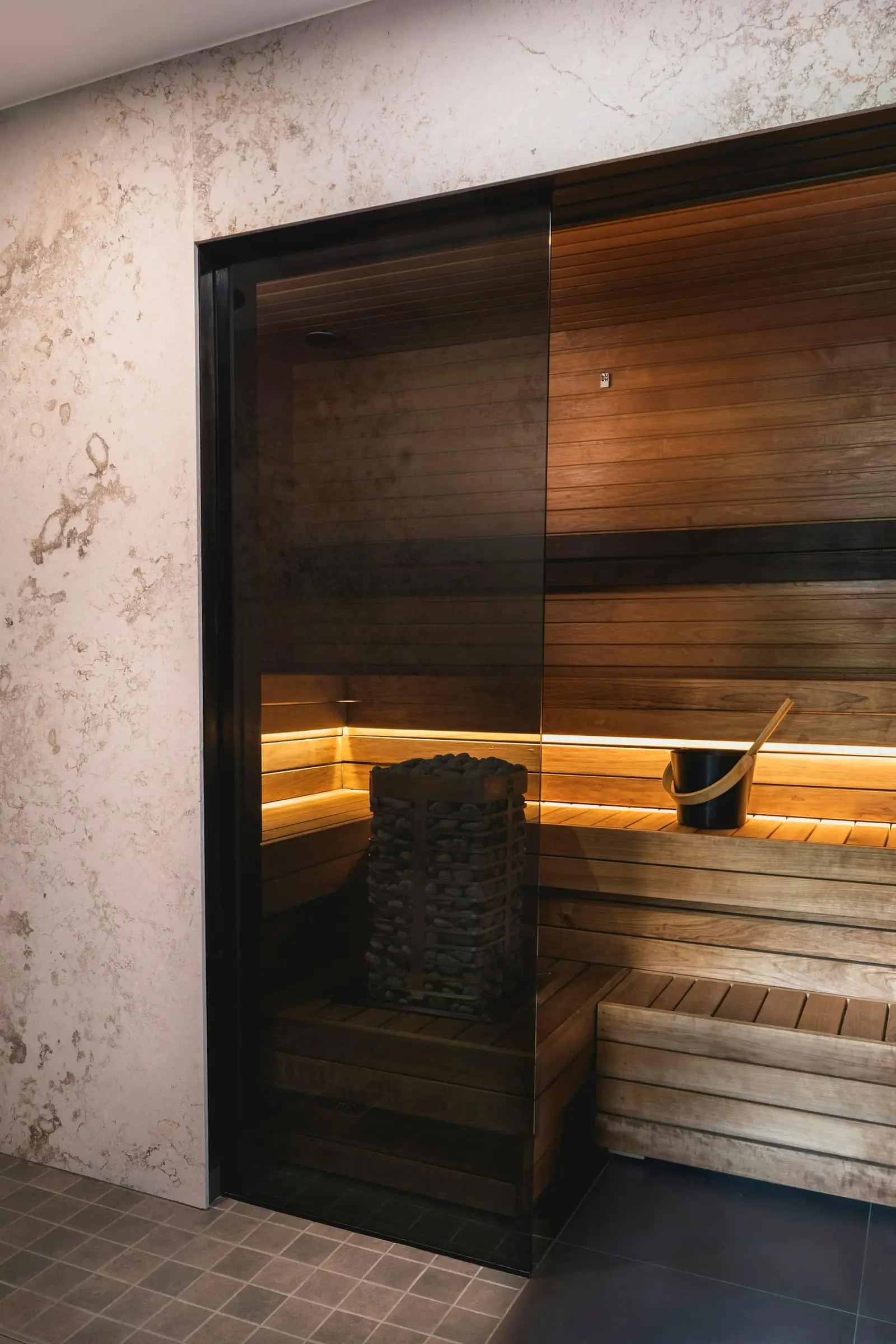
A sauna looks simple: a wooden room, a bench, a box of hot rocks. The simplicity is the point. Every part has one job.
This article explains what each part does and how the two main types differ. For choosing a cabin, start with the home sauna buying guide.
Short answer: a stove heats a pile of stones, the stones heat the air to roughly 80 to 100°C, and water thrown on the stones adds a burst of steam. An infrared sauna skips the stones and warms your body with panels at a lower air temperature.
The stove and the stones
thisisFINLAND, Finland’s official country guide, describes the mechanism in one line: “In all saunas, the stove heats a basket or tray of rocks, and you throw water on the stones to increase the humidity.”
The stove can burn wood or run on electricity. The stones are the storage. They soak up heat and give it back to the room steadily, which is why a sauna stays hot when the door opens.
Traditional saunas, it says, are heated by wood, “burned either in a stove with a chimney or in a stove with no chimney.” The second kind is the smoke sauna, which it calls the original.
How hot it gets
According to thisisFINLAND, the Finnish Sauna Society recommends 80 to 100°C, or 176 to 212°F. Some people are happy at 70°C (158°F).
Home heaters are sized to reach that range. The stated limits in the catalog:
| Model | Heater | Stated maximum |
|---|---|---|
| Finnmark FD-5 Trinity XL | Harvia KIP45B, 4.5kW | 190°F |
| Finnmark FD-4 Trinity | Harvia Vega Compact, 1.9kW | 190°F |
| Sunlighten Solo Dome | 5 far infrared heaters | 150°F |
| Dynamic Andora | 6 far infrared carbon panels | 140°F |
What the water does
The air in a sauna is dry until you add water. Pour a ladle on the stones and it flashes to steam.
thisisFINLAND explains the effect: “the steam increases the feeling of heat and makes you sweat.” The Finnish word for that steam is löyly.
You control it by the ladle. More water, more humidity, a hotter feel at the same thermometer reading.
What the heat does to you
Harvard Health describes the response. Your pulse rate “jumps by 30% or more,” and “the average person will pour out a pint of sweat during a short stint in a sauna.”
That is why every sauna guide says the same two things: keep sessions short and drink water. This is general information, not medical advice. If you have a heart or blood pressure condition, ask your doctor before you start.
How an infrared sauna differs
An infrared cabin has no stones and no water. Panels in the walls radiate heat that warms your body directly, and the air stays cooler.
You get a lower temperature and a plug-in installation. The Dynamic Andora ($2,210.99) runs on a 120V/15A household outlet. You give up steam and the higher heat of a stove.
A traditional heater asks more of your house. The Almost Heaven Salem ($4,176) includes a 6kW heater that needs a dedicated 240V, 30-amp circuit.
Hybrids do both. The FD-4 Trinity pairs a 1750W infrared array with a 1.9kW stove.
Why the room is wood
The sources here don’t explain the wood, so this is my own reasoning, not a cited fact. Wood stays touchable at temperatures where metal or tile would burn skin, and it handles repeated heating and drying.
Even so, the bench gets hot. thisisFINLAND advises a small towel to sit on, “both for hygienic reasons and because the bench may feel rather hot.”
Bottom line: stove heats stones, stones heat air, water makes steam. Infrared swaps all of that for panels and a lower temperature. Pick the type by the heat you want and the circuit you have.
Sources
- thisisFINLAND, “Bare facts of the sauna in Finland,” accessed October 12, 2026: finland.fi
- Harvard Health Publishing, “Sauna Health Benefits: Are saunas healthy or harmful?” May 14, 2020 (opening section): health.harvard.edu
- Finnmark, Sunlighten, Dynamic Saunas, and Almost Heaven listings (heaters, maximum temperatures, power, price), checked September and October 2026